Thursday, February 14, 2013

Bequia: Where to Eat, Part II – Breakfast


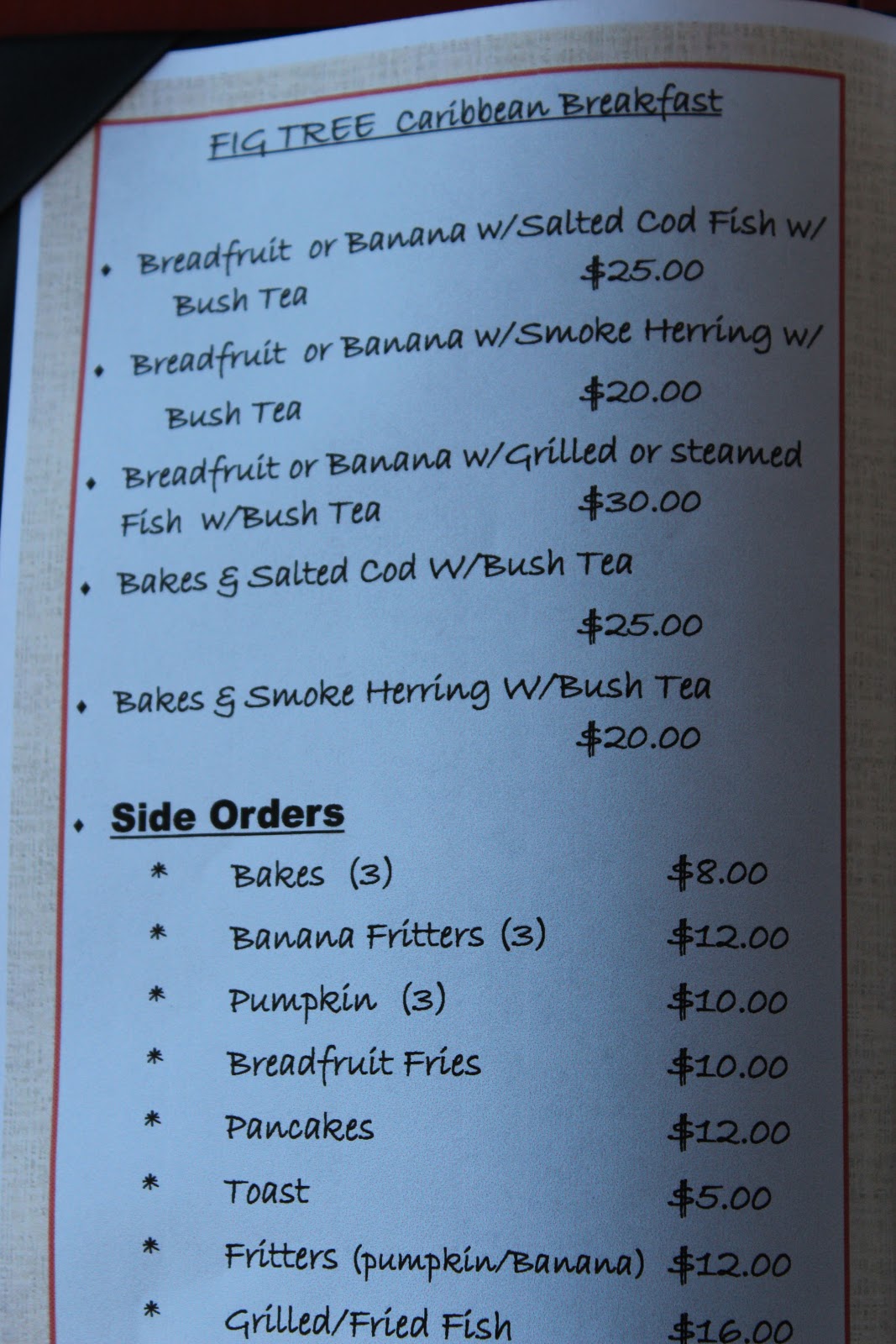
The Fig Tree Restaurant in the thriving metropolis of “the Belmont Sidewalk” (see last posting on the many towns of Bequia) just this week started serving traditional Caribbean breakfasts (see menu above). In what could be called an act of “research for my guidebook” but is more accurately described as “being hungry,” I went yesterday, accompanied by my sidekick Nick, who is always up for a good breakfast.

We had about an hour an a half before an appointment two towns (or one city block) over and knew that was cutting it pretty close, since there was one other customer there and only two waitresses, one of whom I believe was also cooking. One we had had serve us before, and knew that she was a very fastidious drink preparer – like a good half hour to bring bottled water, a lot of the time spent standing stock still in the bar and distressed at all the possible places the water might be. Soon (not really that soon, but I need a transition here) she would bring over a large and a small bottle to make sure we understood our choices (large is fine, we’ll share it). Then she has to return to the bar with BOTH bottles, because, I guess, they were only the demo bottles, and bring back a different large water bottle (“you said, large, right?” – though we might not have, dehydration starting to affect our memory).

Side note: When Nick and I go to the Fig Tree, we often do so because they have the most reliable Internet connection on the island, which is to say, not very but better than most. Because we are taking computers, we will sit at one of the large tables (see picture below, taken on the very day in question). So scene is set – 1000 words saved.

On returning with our actual large bottle of water, and not the demo large bottle of water, she stands with it, again silent and distressed, then (look at the picture again) asks Nick to move his computer because she can’t figure out where else to put the water.   After he does that, because it is better not to argue since there might be some sort of unknown feng shui reason that the water can only sit directly in front of Nick, she waits a couple of beats, then asks: Do you need glasses? No, no, this is great we assure her, we’ll just slug from the huge bottle, being so tight on space here at our enormous table.

So yesterday morning, when we saw the careful drink preparer on duty, I knew that I had to get my coffee order into the other waitress on call. But as she was heading toward us, Nick – damn him – asked, is the Internet working….

…Noooooo, it was like it was happening in slow motion. I moved to clap a hand over his mouth, but without caffeine, was too slow. Our waitress turned in mid-stride and without our coffee order. She wandered silently back toward the router and started checking the connection with her iPhone. Turns out, the Internet WAS working, just not on her iPhone, until about 30 minutes later – at which point she brought us the menus (or Nick tells me that’s what happened. I was face first on the table in coma).

Like a good set of smelling salts, the specter of breakfast with salt cod or boiled fish snapped me out of it in time to hear the blessed words: We don’t have any Caribbean breakfast.  She said both the smelly fish and the breadfruit deliveries were held up, or were never ordered, or were never even contemplated (this is communicated by a vague hand gesture which is the island signal for “something, somewhere, I really have no idea and don’t care”).

For me, this was tremendous news. While I would not say no to a nice bake (like flat rolls, freshly baked to order, and excellent as long as someone doesn’t put a bunch of boiled fish on top of it), I am not big on fish for breakfast, especially fish like salt cod which is preserved for lengthy sea voyages and meant to be eaten with a tankard of rum. And I can’t stand breadfruit, which tastes like neither fruit nor bread and has the consistency of Play-do but without the flavor.

And, in a later rare bit of research, I looked up what bush tea was – and the first entry I find (which means, as I understand, it must be accurate) is from the Jamaican Observer online edition and reads in part:

POPULAR bush remedies, or 'bush teas' widely consumed in Jamaica and other Caribbean nations have been found to be potentially harmful in recent scientific studies and appraisal by the University of the West Indies (UWI), Mona, St Andrew. Among the bush teas identified by the studies as favourites across the Caribbean are cerassie, annatto, peri-winkle, dandelion, vervine, guaco, cashew bark, coconut shell, aloe vera, and cannabis satira (marijuana). The studies said that although these "bushes" had possible beneficial ingredients, they also had potential toxins which could be harmful to individuals. It noted that use of bush remedies had greatly impacted the health of the region.

Dodged a bullet on that one…

So the menu that was on offer was the same selection found at every other restaurant on Bequia that serves breakfast: Eggs with bacon or not, toast (usually excellent homemade bread), pancakes, or an omelet (vegetarian OR cheese but not both, since I believe there is a law against it). Fruit juice or coffee.

We had omelets, which were quite good, and the rest of breakfast went off smoothly, though Nick asked not to have peppers in his omelet then joked that I could have his peppers. Ordering being a serious business here in the islands, that caused a delay while our waitress tried valiantly to figure out if there were not some sort of policy against pepper swapping (and whether that violated at least the spirit of the vegetable/cheese omelet distinction) and then spent another good while marveling that someone would joke about such a thing. Another brief snag occurred when the coffee showed up, hovered in its Holy-Grail-like silver pot on a tray with our coffee cups (we didn’t even have to ask for them!) right above our table, and then the waitress pull it back and went back to the kitchen because she had forgotten to put the milk on the tray (I don’t take milk! I don’t take milk!). But in the end, all was well, and we were only one half hour late for our appointment.

Note: The Fig Tree serves up some of the best West Indian cooking on the island, it is reasonably priced, and its Friday fish dinners are legendary (fish cooked any way, take out available, which is rare on the island and, if requested, usually leads to a leaky plastic bag of mixed up food some of which is bound to be breadfruit).  In addition, the place is a bit of a local hang-out, because of the good Internet and because owner Cheryl Johnson runs and hosts there the popular BequiaReading Club staffed by volunteers from the ex pat community and visiting yachters.

Other places for breakfast (same menu, without the fishy stuff) include the Gingerbread Restaurant (Belmont), which has a fabulous upstairs covered porch which gets a nice breeze and looks out over the bay (Internet costs $10 EC here, though, and involves a lot of work, a consultation with the manager, a trip for him back to some secret Internet room to get a printed receipt with your multi-character username and password, and that takes several entries to get the thing to work because the receipt printer is almost out of ink); Gingerbread also has a lovely outside area right on the water and under a big tree and a small bakery where you can get specialty coffees, fresh squeezed juices, and all manner of baked goods, including, not surprisingly gingerbread; The Frangipani (Belmont), which serves up the unexceptional standard fare unexceptionally (my next post will be a spot of creative writing about the Frangi); and Maria’s French Terrace (Port Elizabeth) where the omelet just edges out the Fig Tree’s for first place, but that is because the owner is French and really lays on the butter.


Saturday, February 9, 2013

Bequia: Where to Eat, Part I

Port Elizabeth, Hamilton, Cemetery Hill, O’car Reform, and Belmont from Old Fort Hamilton, Bequia


[NOTE: I am cross-posting this to my Active Voice (writing) blog and my Green Fence Farm (farming and eating) blog, which means that the 14 of my Facebook friends who signed up for the Active Voice and Green Fence Farm pages will get multiple notices. I’m a little bit sorry for that because I know you liked both pages, not because you actually LIKED them (in that junior high school crush sort of way), but because you felt sorry for my feeble attempts at taming the social media lion and wanted me not to go back to sending you updates, many of which looked like manifestos from psycho-killers, just not quite as well written, typed on my (self-correcting, mind you) electric typewriter from college.  I’m only a little sorry because I do like the impression the multiple posts (of the same piece) gives of great productivity on my part.  And the reason this is ending up on the Green Fence Farm page is that, though I am on an island (Bequia) and nowhere near the farm right now, I am still eating and writing about it.]

When I last wrote, I was pondering the impossibility of ever writing my planned guide to the island of Bequia because I had discovered I was going to have to do research, which could involve a lot of work (THIS is why I know I am destined to be a fiction writer, or one of those essayists who just looks out the window and writes about birds, because I am much better at making shit up than researching, especially if it involves leaving my chair, which I take great pains to put in an interesting place (Look! Birds!) and pillow up adequately).  

This whole research problem reared its ugly head when I realized that my “Where to Eat” chapter was going to involve more than just going to a bunch of restaurants and eating a bunch of courses (something I am particularly good at). No, I would have to taste Nick’s food too, which will be a struggle because one of the tenets on which our marriage is based is a commitment not to share food. I’d have to interview the owner or the chef – who around here is either going to be a native Bequian or a Scandinavian (and I can’t understand either accent) and get some quaint story about how they wanted to continue their dear mother’s tradition of boiling the crap out of stuff in crockpots or how their grandfather always dreamed of coming to the tropics and smoking fish. And I would have to RESEARCH (see? That word again) the hours and addresses of the places.

I know what you are thinking – “you’re going to the places, you must at least already know the addresses” – but you would be wrong, which is why you have not yet written a travel guide (unless you have, in which case, it is why you have not written a travel guide to Bequia). There are no addresses here; there is no mail delivery (see previous post on guy handing mail out of the back of the ferry) and only one main road, which was built, I believe, by the Romans and hasn’t been maintained since (OK, you homeschoolers, don’t write that last part down, I made it up: the bit about the Romans, that is, not the maintenance).

What there are are many, many, many “towns.” Most of these would fit into what we on the mainland would call “a block.” Some would fit into what we would call “two huts and an abandoned rum shack with a goat living in it.”

For example, the main grouping of towns (which the locals refer to, confusingly, as “town”) consists of the following: Port Elizabeth, Hamilton, Cemetery Hill, O’car Reform, and Belmont. There cannot be more than 100 structures total in these towns, and from any place in anyone of them you can pretty much see all of all the rest of them.

The ferry from St. Vincent arrives in Port Elizabeth, which is also referred to as the capitol of Bequia in any tourist guide you can find. So, the traveller coming into the port would assume, as I did, that the groupings of houses and a couple restaurants to your left; the half pedestrian mall, half street (with a boundary that is fluid and the subject of vocal controversy, mainly among pedestrians who have just had their feet run over and the taxi drivers that did the running over), shops, stands, and a government building in front of you; and the waterside cafes and small hotels to your right were all part of the thriving Bequian capitol, Port Elizabeth.

You would be wrong.

In fact, as far as I can tell, Port Elizabeth includes only the port itself; the tourist information building right as you exit the port, the lady selling knitted Rasta hats to its left; the tree under which the taxi drivers hang out and discuss how much they hate the current government and why tourists keep sticking their feet under their cabs’ tires; the government building across the street; and a small canal of festering runoff from the gutters. If you walk from that government building less than a dirt road block to Knight’s Food store, you are in the town of Hamilton. A block to the right and you are in Belmont. A block the left you are in O’car Reform. Cemetery Hill? To the right and up another block from the port, near the cemetery (duh). The whole metro area can be walked in about 10 minutes, 15 if you stop for ice cream.

The Port Elizabeth/Hamilton distinction really tripped me up our first week on the island. We had asked Cass, our housekeeper and native Bequian, where to get groceries. She informed us that Hamilton had a Knights (the Bequian version of Safeway, except without the parking lot, pharmacy, produce section, soda section, meats, or pretty much anything but rum, fruit juice, canned beans, and staples tied in small plastic bags without labels so you have to smell everything to make sure it is salt, for example, and not laundry detergent. Knights deserves and will get its own post later).

Nick did the first shopping trip on his own, and later that day, as we were driving to a restaurant in O’car Reform, he pointed out the store, which is about the size of a White Castle, and I said, “So that is why you came home with only a can of pigeon peas and a small bag of laundry detergent. You were supposed to go to the store in HAMILTON,” which I assured him was no doubt a fabulous marvel of megastore efficiency, with Whole Foods-like displays of local fruits and Starbucks coffee.

Despite the fact that, by the time I had finished saying that sentence, we had arrived at the restaurant that was in O’car Reform – and despite the fact that I knew from Cass that O’Car Reform came after Hamilton – I still insisted that we go the next day to find the real supermarket in Hamilton.

We took the main road over the pedestrian mall, by the port and the restaurant from the day before, around herds of goats, school children, and a guy carrying a fish on his head, persevering even when it really seemed the road had turned into someone’s driveway and finally got to – a dead end at a lookout and a historic plaque about the fort that used to be there (also a couple of old canons, which made the trip not a waste for Nick).

So, yeah, the Knights in Hamilton is the Knights that is 20 feet from Port Elizabeth, and Cass had a huge laugh over us driving “all the way” to Old Fort Hamilton (like we drove from DC to Beckley, WV looking for a Sam’s club). The island communication network being what it is, that story made the rounds pretty quickly, and I think I heard a local guitar group singing a ballad about it a couple nights ago (“Oh the stupid white man and his fat wife, drove all the way to Old Fort Hamilton looking for a store, do dah, do dah), though it could have been Day-o. I really have a hard time with the local accent.

Apologies for my Green Fence Farm readers that I have yet to get to anything about food yet, unless you consider laundry detergent a food, but I will in the next post, at which point you will, I assure you, appreciate all this essential background information.

Next post: Bequia: Where to Eat, Really This Time, Part II

Monday, February 4, 2013

Bequia: Getting There


As this blog’s loyal readers (hi again, Mom) know, Active Voice is transitioning from a moderately successful writing and editing firm to pretty-much-destined-for-failure vanity publishing house specializing in Nick’s adventures novels (well, really only one at this point) and textbooks and my…various writing projects of an undefined nature and genre.


(This is the point where I remind everyone that I will still happily take speech and other writing gigs or corral my editors – who aren’t as enthusiastic about publishing our own stuff as they were about, say, real jobs – to clean up your presentation, proposal, report, or capabilities statement. The joy we feel at fulfilling our destiny as writers – not unlike the joy we felt at fulfilling our destiny as farmers – has yet to put any bread on the table (at least with farming we got the odd zucchini)).

The Active Voice offices are currently running our of a small apartment above Princess Margret Beach on the West Indian island of Bequia. We have been here two weeks and will stay another two.

Before we came, I decided that my first writing project would be a tourist guide to Bequia, with Nick filling in some of the historic bits, since he has researched the history of St. Vincent (Bequia is an hour ferry ride from St. Vincent, where the capitol is, and is part of the country St. Vincent and the Grenadines). He had planned to write a book on colonial times down here, which were quite exciting, with the British and the French both trying to wrest control of the various islands from each other and from the fierce native Black Caribs. Meanwhile, pirates sailed around through it all – Blackbeard spent a good deal of time in Bequia – wreaking havoc and conveniently crashing into rocks and spewing treasure around (that is Nick’s theory, anyway, which is why he brought his metal detector down here, and why he only has one pair of pants: he had to dump almost everything but the metal detector to make the Liat air baggage weight limit).

Nick pulled together a lot of source documents. We planned trips to libraries in New York and London to look at some of the original diaries written by the settlers (actually, Nick planned that, and I planned where we would go out to dinner afterwards). Then, a few months before we got here, Christopher Taylor – a real professor of Caribbean studies, if you can believe it, with a publishing company that he didn’t have to found himself -- released “The Black Carib Wars: Freedom, Survival, and the Making of the Garifuna.” We knew Nick’s project was dead when we read in the introduction something along the lines “thank you, Pierre François, for your help with my rusty Old French in translating a bunch of letters we had never heard of (of course not! They were in Old French! We don’t read Old French! We don’t even read Menu French!).”

So, we had to admit that the world probably didn’t need another history of the islands. No, what the world needed was a detailed work discrediting everything this so-called “Christopher Taylor” has ever written -- with chapters making fun of his physical features, which we hope and assume are grotesque (still looking for a picture). But, as we developed the business plan for the project (unless Christopher Taylor has some bitter ex-wives, probably fairly small target audience) and reviewed the libel laws, we realized that all the guy ever did was share our interests and be a lot smarter than us. So Nick decided instead to spend his time here looking for gold (which, if he finds it, he will take to Christopher Taylor’s house, fling it at him, and yell: “So, Pepe Le Pew, How come you didn’t know about this!”) and I was going to write a guidebook.

Was.

OK, maybe still am, but I have encountered several false starts.

Our first day here, I sat down to write the chapter that everyone knows is the first chapter in a guidebook: “Getting There.” Having just got here myself, I felt unusually qualified. I gathered:

The several grocery store-like receipts, stapled together and to my passport, that make up Liat air’s complicated ticketing system for its multiple stop flight (through three Caribbean countries and their unique and colorful immigrations and customs systems) from Puerto Rico to St. Vincent.

The schedule for the ferry from St. Vincent to Bequia. I didn’t have a ticket because we just got on the ferry, up the creaky metal plank behind the cars, then further up some very steep metal stairs (tip for the disabled traveller: Don’t get on this ferry.  I have no idea how you are supposed to get to Bequia) to where they store the humans for the ride. We had tried to buy a ticket at the office outside the ferry, the one with the sign that says “TICKETS FOR THE FERRY TO BEQUIA,” but there was no one in, and a guy in an official looking jumpsuit told us, derisively, “That’s not where you get tickets.” When Nick asked him, “Where then?” -- the guy yelled, “On de ferry! On de ferry!” introducing us to the quaint island tradition of explaining things to idiotic tourists (usually white, usually us) by bellowing simple instructions twice – under the assumption, I suppose that we are both deaf and incapable of understanding complete sentences. So, of course, no one asks for or sells us a ticket on the ferry, and we see no one else engaging in ticket commerce. Nick finally ended up just giving some money to a confused guy handing out mail on the lower deck when we arrived in Bequia.

These source documents assembled, I settled down to write and immediately realized I had missed several important steps. First, I should have a section on flights to Puerto Rico where you catch the Liat flight. But seriously, I would hope my readers are smart enough to know how to look up flights to Puerto Rico online, and if they aren’t, then I would not recommend Bequia as their first foray into air travel. Start someplace easy, like Cleveland.

Second, I needed to list some interesting hotels in San Juan, PR because, though your savvy Internet searches will show that American flight arriving in plenty of time for you to transfer to Liat and get to St. Vincent, in truth, Liat often pushes up its departure an hour or so if they have someone who wants to go to an island not normally on the itinerary.  And no, they don’t tell you when they do this. They don’t even announce it at the airport. You just have to be at the right gate within three hours of the scheduled departure, and eventually someone will open a door and say “Walk to that plane over there.”

Third, I forgot to explain how to get from the airport to the ferry once you land in St. Vincent. You can’t. The plane doesn’t get in until late and the last ferry goes at 5 PM. So you will be spending a night in St. Vincent too. Again, a proper guidebook would have a list of hotel options for St. Vincent and information on how to negotiate with the cab drivers outside the airport (you can’t. It is dark, you have no idea where you are, you forgot the exchange rate, and you can’t understand anything they are saying), but what is just much easier is for you to stay at Tranquility Beach Apartment Hotel, and Lucelle will pick you up at the airport and take you to the ferry the next morning.  Just don’t ask her to go early, because of all the traffic, and there is no sense in that (or, as she told us: “No sense in that! No sense in that!).

Lucelle, smiling because you are not making her go into town during morning rush hour.
Bottom line: It takes three days to get to Bequia through St. Vincent, making it not the best place for a one-week vacation.  If you are determined, you could try a regular airline to Barbados then SVG airlines to Bequia’s own airport. The New York Times ran an article on Bequia a couple of years ago (“Bequia: Getting AwayFrom the Getaways”), and their reporter left New York at 8 AM and got to his hotel on Bequia by 5:30. (He said that “getting there requires a bit of effort, patience and expense,” but, since he did it in less than 24 hours, I would have added to his list “…and incredible luck”).

In the interest of a well-researched guidebook, I checked out SVG’s website to see if perhaps we had been foolish to use the St. Vincent route all these years, and pretty much the first thing they tell you is to make sure that before you board, you have a toothbrush and any medicine you might need in the next week or so, because chances are, you -- or you and your luggage -- are not getting “there” anytime soon. 

Chapter One of the book, therefore, remains unwritten because I am afraid that compiling all this inside information in a useful way will be (a) exhausting and (b) depressing, so I put this chapter aside to tackle the also-standard: Where to Eat.

Next blog post: Why I also do not have a chapter yet on where to eat.


Monday, December 3, 2012

Inactive Voice No More

The Tiger of Malaya -- he hid the treasure Nick is after in his upcoming novel, Steele's Treasure. Read on to find out why your should care.


            So, we’ve been kind of quiet lately.

            For about nine months now, Active Voice has been going through a transition (we are studiously avoiding calling it a midlife crisis because, well, frankly, we are getting a bit too old for that). For several months during late 2011 and early 2012, we attempted to make ourselves into a serious, innovative, 21st century entrepreneurial start-up business. We had the wonderful Young Kate, a twenty-something writer and thinker, attuned to all the pop culture stuff we stopped following in the early 90s. We had a hip co-working space on U Street, where hip people go to music shows that start way past my bedtime, get tattoos during their lunch hour (I originally wrote “on their lunch hour” but that sounds like a euphemism for some not for Prime Time body part), and participate in nigh-endless conferences on social media, app development, and “doing well by doing good.” We developed little business beyond our base clients during this time, but I was whipped into a constant state of frenzied anticipation from all the positive conferences, peer discussion groups, and life coaching lectures I attended.

            And then I shattered my kneecap walking downstairs to my apartment.  I am not sure why, but that snapped the entrepreneurial spell that had kept me in thrall. In a full leg cast, I couldn’t ride the bus to my ecofriendly workspace so I sat at home, fretting over Christmas cooking arrangements. I couldn’t go to the Caribbean for a month, as Nick and I had planned, since I couldn’t wedge the broken leg onto an airplane, so we booked a train to Key Largo instead, and I stayed, then went back, for longer than any young entrepreneur worth her salt would. I started thinking that maybe I had mistaken the universe of government contractors who could not put together a literate sentence for a market-worth of opportunity, when in fact they were a clan speaking their own dyslexic patois, and happy to keep doing so forever.

            Don’t get me wrong: I treasured – treasure – loved – love – my steady, longtime speechwriting clients. I want to keep each and every one of you, forever, really I do.

            But for the rest of the time, I need something different. I think I need to write some books, And I think I need to publish a few more.

            So starting in the New Year, when I am done with my current project, Active Voice will focus on writing our own books – and publishing one of Nick’s. He has finished writing, and we are over-editing, a fabulous adventure story about searching for gold and bucking authority in the Philippines of the 1980s.  Watch this space for more details, but I will let you know that pygmies are involved and Fredda Sparks (my mother and Active Voice VP for editing), who is in charge of the final copy edit on the book, has determined that “shitfaced” is, in fact, one word.

            Steele’s Treasure by Nick Auclair, available on line and in stores, Spring 2012.


Monday, April 16, 2012

Protecting privacy in a TMI world

Active Voice was as excited as a corporate name can get to work with FTC Chairman Jon Leibowitz and his outstanding staff in producing this oped that ran in the Washington Post a couple of weeks ago. It is notable not only for its pithy (always!) exposition of an important and technically complicated subject (privacy – yours – online), but it was almost 1000 words. For years, I have told clients that unless they are Henry Kissinger (who gets to fill the center of the NYT and WaPo oped pages every time he has another thought on Afghanistan), they better spit out their points in less than 700 words. So we dutifully sent in our 700, and they asked for more! Twice!

I was also pleased they used our title: I think it was very hip to have come out of the mind of a woman who uses the word “hip” without intentional irony.

Kate

Thursday, March 15, 2012

Private Parties


I’ve been feeling quite private lately.  And in true 21st century fashion, I am celebrating that by posting my private thoughts to a public blog – though given the number of readers I seem to have, that is akin to mumbling them quietly to myself, so the irony is a bit lost.

And in truth, the discussion about private discussion is becoming more public every day.  With Facebook, in settling a federal case, admitting that they had not taken their users’ privacy seriously when they willy nilly changed privacy policies, releasing all manner of users’ information to the cyberworld without making much effort to ask permission or even explain that it was happening – and with Google pulling a Big-Brother-we are-amassing-a-huge-online-dossier-on-you-for-your-own-good move recently (and then telling those who balked, “fine, go ahead and use some OTHER search engine to “google”) – people are starting to wake up to the fact that to get a ticket on a plane bound for cyberspace, you have to hand over control of information about everything you do, see, buy, and say once you arrive.  And you though TSA strip searches were outrageous.

Our friends and clients at the Federal Trade Commission have been worrying about this for a long time.  In a report in late 2010, they proposed a Do Not track mechanism that would let Internet users make choices about who can collect data about us as we travel the Web.  Chairman Jon Leibowitz recently went to the White House to talk about private industry’s response to Do Not Track.  You can see his remarks, on which we helped, here:


And at the end of last year, we worked with Commissioner Julie Brill to elaborate on some of these subjects at International Association of Privacy Professionals (IAPP) Practical Privacy Series.  Her remarks are here:


Kate

Thursday, February 9, 2012

The Argument on Semicolons: More Heated than a Team Edward-Team Jacob Forum


A squiggle and a dot: the greatest points of contention in history (among some circles).  The semicolon has been much used and abused in its four hundred-odd years.  Seventeenth and eighteenth century writers did nothing without it; in the nineteenth century a rebellious few voiced their abhorrence, and for most of the twentieth century it was in to deem semicolons as decidedly out

 
No other punctuation mark has been so loved or hated, almost to death even (among some circles). And like most things feared or revered, it's been widely misunderstood. It's been called bourgeois, lazy, pompous, old-fashioned, addictive, and too subtle for the brain of man to grasp. It still makes headlines in France.

Writers have been weighing in for nearly two hundred years, and the vote is pretty much split. Who are the friends and enemies of this controversial little mark? Which camp do you belong to and why?

Friends
Virginia Woolf
Ben Jonson
Truman Capote
Ben MacIntyre
Marcel Proust

"You practically do not use semicolons at all. This is a symptom of mental defectiveness, probably induced by camp life."  - George Bernard Shaw

"I like them — they are a three-quarter beat to the half and full beats of commas and full stops. Prose has its own musicality, and the more notation the better." - Will Self

"But with the semicolon there you get a pleasant sense of expectancy…" - Lewis Thomas

"But how much notice should we take of those pompous sillies who denounce the semicolon? I say, none at all." - Lynne Truss

Enemies (aka Pompous Sillies)
Ernest Hemingway
Stephen King
George Orwell
Edgar Allen Poe
Somerset Maugham

“The semicolon has become so hateful to me that I feel almost morally compromised when I use it.”  - Paul Robinson

“Ugly, ugly as a tick on a dog’s belly.” - Donald Barthelme

“How hideous is the semicolon.” – Samuel Beckett

"But do not use semicolons. They are transvestite hermaphrodites, standing for absolutely nothing. All they do is show you’ve been to college." - Kurt Vonnegut