Showing posts with label Caribbean. Show all posts

Tuesday, March 5, 2013

Eating Out in Bequia: Lunch and Dinner

Remains of lunch at the Sugar Reef Restaurant and Bar, Crescent Bay, Bequia

            It is 25 degrees outside my office right now, and a storm that is going to dump 10” of wet snow on the farm is headed this way tonight. That’s okay, though, because we are driving to DC later today so I can catch a train in the middle of the blizzard and enjoy it in Brooklyn, which is known for being a tropical paradise this time of year.
            So yeah, we’re back from Bequia.
            But I am determined to continue my now renamed “Unofficial and Bad Guide to Bequia” with more of the “Where to Eat” section. In all honesty, I couldn’t write this the last couple weeks we were there because it had gotten to the point where if one more person served me, pretty much no matter what I ordered, a plate of dry baked kingfish and rice, I was going to leap across the table and stab probably her (most waitresses are women) with my little bundle of silverware tightly wrapped in the world’s thinnest paper napkin (where do they find those?).  Now that I am back and have had a couple of “beef” dinners that were not in fact “goat” or “kingfish,” I have regained my composure and can press on.
            I have to start with an apology. I do not, as the picture at the top of this article demonstrates, have very many photos of Bequian fare. Problem is, I am often hungry when I go on my fact-finding missions and forget to take a picture of the food before scarfing it. Also, photographing one’s plate in restaurants is looked down upon by Nick (and Tom Sietsema of the Washington Post, according to several pieces of his I have read but now can’t find. I did try but (a) the searching was starting to feel like research, to which I am morally opposed, and (b) the exercise was disintegrating into me making a list of DC restaurants which I will never go to because I am too old or too poor).  When I did remember to take a few shots before digging in, Nick would react with exaggerated sighs and eye rolling as well as playing to the crowd (even if there wasn’t one) with silent appeals: “What are you going to do? She was sane when I married her.”  His drama would increase if I were going for an art shot, crouching down to get just the right angle on my dry piece of kingfish.
            Lunch and dinner menus are usually similar in Bequia, with one exception. Roti, a meat (fish, chicken, or “beef”) dry stew in a naan-like bread (from the “Indian” part of the “West Indian” tradition) is served at lunch while the stew minus the bread and poured over rice is the dinner version, usually called something like “fish, chicken, or ‘beef’ (though they leave the ironic quotation marks out) over rice.” Most restaurants also offer “fish, chicken, or beef lunches/dinners” which are the same thing, perhaps a little drier, next to rice. Occasionally you will get the big three offered as a curry, which is back to the stew with curry powder, over rice.  Unless it is a curry soup, and then the standard mixture is watered down and no rice.
          Bequians are good at soups, and I very much enjoyed their calaloo soup, which is made with what they say is “spinach” and what we know as “anything that looks like it could be spinach when it is ground up.”  In a separate post soon to come on the Green Fence Farm blog, I will discuss recipes for Calaloo soup and my search for spinach that could grow in year-round 85 degree heat (spoiler alert: I found it and asked the farmer what it was. He said spinach. I then asked how he grew it. He said from seeds. I asked what kind of seeds. He said spinach seeds).  The seafood chowders and curries are excellent and fresh, and there is a speciality called “goat water soup,” which I (thank God!) never found on offer.
            The fish one finds on menus (almost always identified just as “fish”)  is usually kingfish, mahi-mahi, or barracuda, which Nick warns you not to eat because, besides tasting bad, it will give you some nerve disease and boils (actually, he didn’t say “boils.” I added that. I assume it is true since a startling number of plants and food in Bequia can give you boils. I honestly thought boils went the way of leprosy and leeches, but good on Bequia for keeping the old ways alive. Look for a future post on touring in which we visit the ocean pool built for bathing lepers. Not kidding).  Grouper is never offered, and if you ask for it, they will explain it prefers the Bahamas, and they take that kind of personally.  Red fish, which is always good, is sometimes an option.
           You can get lobster, served broiled or grilled, for dinner almost anywhere. The Caribbean lobster has no claws (they do have legs, just not ones big enough to crack open and eat) but make up for that with enormous tails, which is all of them that anyone consumes. The meat is sweeter than Maine lobsters and a lot easier to get at since you don’t have to waste time pretending you are eating all that suspect, lung stuff in the body. The price of a hunk of lobster is about what it is in the U.S. and exactly the same across the various restaurants because they don’t have antitrust laws on the islands.
            I saw several versions of shrimp, but no one farms or catches or herds shrimp in that part of the word, so I avoided it figuring it was either out of Florida or out of cans. Tuna, mostly on nicoise salad, ran the gambit from fresh and just seared to cat food, so take your chances or wander around pretending to find the restroom and see if anyone else ordered it. You can, of course, ask if it is fresh, but the answer will always be “yes,” because the islanders hate to disappoint or be negative (it is your vacation, after all).
            Conch is local and usually fresh, or as fresh as a tarted-up slug can be. The consistency of conch is like squid, but a little tougher and the taste is under-seasoned rubber band. Despite this, or perhaps because of it, Bequians abandon their favored grill-it- stew-it-or-bake-it-and-dump-it-over-rice cooking method and do some interesting things with conch including conch fritters (spicy cornbread with little enough conch that you don’t have to worry about its taste or texture) and something call “conch ting” which is conch cooked as tender as it will ever get in loads of garlic and butter and poured over rice. This is touted as a powerful aphrodisiac at at least one restaurant we visited. Then again, a huge variety of local foods and drinks are sold as such, which might explain the large number of children on the island.

Next post: The Bequian Wait Staff Tradition: Lightening-Fast Inefficiency


Saturday, February 23, 2013

Bequia: Christine on the Belmont Walkway


Along with my guidebook to Bequia, which I will never finish, I’ve been working on a series (OK, one so far and it is far from done) short stories set on the island. I finished a very long first draft of the first, which was to be titled “Island Girl,” after the Elton John song. I was tremendously pleased with it and ready to ship it off to the New Yorker who I was sure would take it despite its great length and first draft status, because obviously I am a prodigy, or whatever the prodigy moniker is for an old women.
Then I read it again and realized that (1) there were a lot of words and not a whole hell of a lot of story (though that is not usually a disqualifier for a New Yorker piece); (2) the characters were not that compelling or even necessary, and I couldn’t imagine anyone really caring what happened to them (as long as they just shut up and got off the page); and (3) these dull characters were actually in the wrong story.  They may have a story some other time or place, but not here.
Which left me with several pieces of shrapnel from my original piece – some descriptive writing that I still quite like and think captures the feel of the island well, and a decent ending in search of the correct characters to play it out. The latter is my problem and I am working on it. The former is, if you are still reading, your problem, because I think I will pull a couple of the descriptions I liked out and put them here. Below is the first one and introduces Christine, the now furloughed main character of Island Girl.


Christine on the Belmont Walkway

Christine made her way to the hotel’s outside restaurant and lowered herself onto a brown-lacquered picnic bench under a wooden awning. She stretched her legs away from the table, pushing ridges into the sand floor, and contemplated her mosquito bites, sunburn, and chipped pedicure.
            Just a few feet beyond her legs ran the Belmont Walkway, an uneven path that separated a line of small guest houses and outdoor bars from Admiralty Bay – certainly the most stunning natural anchorage in Bequia, and probably in the entire Grenadine chain. The car ferry from St. Vincent cut a path toward the port at the bay’s mouth, the hulking steel rectangle creating surprisingly little wake to disturb the private sailing yachts, gleaming white and flying vaguely familiar European flags, and local fishing skiffs, painted carnival hues of purple, yellow, and orange, emblazoned with names like “Fat Man,” “Muscle Flex,” and “No Complaints.”
Resting her back on the table edge, she watched two older Bequian women standing waist deep in the mottled turquoise water past the walkway, modest one-piece swimsuits and bathing caps. They laughed at a friendly remark from a shirtless, sculpted young black man on the shore. Christine wondered what it would be like to live in a place where you could step off the sidewalk of what was essentially the main commercial drag into a bathwater warm, crazy clean sea, and bob companionably as neighbors passed by on their way to work.
            Christine wondered what it would be like to live in a place where being fat was an asset, or at least no big deal. The two women, one with jiggling arms raised high, joined a debate that had sprung up between three young men on the sidewalk arguing about the best way for a befuddled German tourist to maneuver his dingy into the small dock.
            “They are fat,” thought Christine, practicing using the word, because the women were her size, and she was not used to calling herself “fat.” She contemplated why the island women’s fat looked so much better on them than on her. Was it because they were so very black and, especially in the water, looked sleek, like sea lions? Her own pale white skin was mottled – with uneven sunburn, scabby bug bites, weird, teeny bruises that appeared in new spots each morning -- like she spent the night being beaten by an enraged elf -- and shadows in various places where her skin bulged, folded, or puckered.
            “Good morning, love, have they brought the coffee round yet?” A heavy (not fat, thought Christine, like me) woman, doughy face surrounded by a halo of graying brown hair, groaned as she maneuvered in the picnic bench. “Wouldn’t you prefer a proper table for your breakfast, love? I am afraid I will rip my shorts getting in here.”
            “Good morning Sybil,” Christine didn’t turn to face the older English woman, not ready yet to leave her imaginary participation in the saga of the German guy’s boat, which now involved a lot of rope, three more people in the water, one a fully dressed, possibly drunk or, more likely, high, Rastafarian complete with machete and knit cap, and several school children massed on the sidewalk, white, button-down shirts untucked from black pants and skirts, alternatively offering incomprehensible advice and shouting “Squid! Squid!” at what must have been a squid hovering around the small craft. The German, who, if he understood English at all, certainly did not understand the patois spoken on this particular island, sat in his boat, nervously scanning the water where the children pointed (what did he think they were saying?) and limply holding one end of a rope that the Rastafarian was inexplicitly wrapping around the engine.
A loud splash and excited chatter and laughter from the dock heralded the tableau’s inevitable conclusion and attracted a young waitress close enough to their table for Phyllis to snag her.
“Do you think we could order breakfast, dear?”
The waitress, “Stacey” according to her nametag, stared at the couple with the languid, slightly amused detachment that seemed to come standard issue to the young women on the island.  Phyllis then began her morning ritual of describing in great deal how their meal should be cooked (“coddled, dear, then you must let it drain in a slotted spoon – you’ve have those here don’t you – for a least a minute, then slip it next to, but not on, one buttered piece of wheat toast…”).
“Did you get that dear?” Phyllis pressed. Stacey smiled slightly and widened her eyes with a look that said both “Do you really think I am that much of an idiot?” and “Nope.” The eggs would come, as they always did, over easy, yolks cooked solid, toast in a basket on the side, butter for the asking, if Stacey could be found.

Thursday, February 14, 2013

Bequia: Where to Eat, Part II – Breakfast


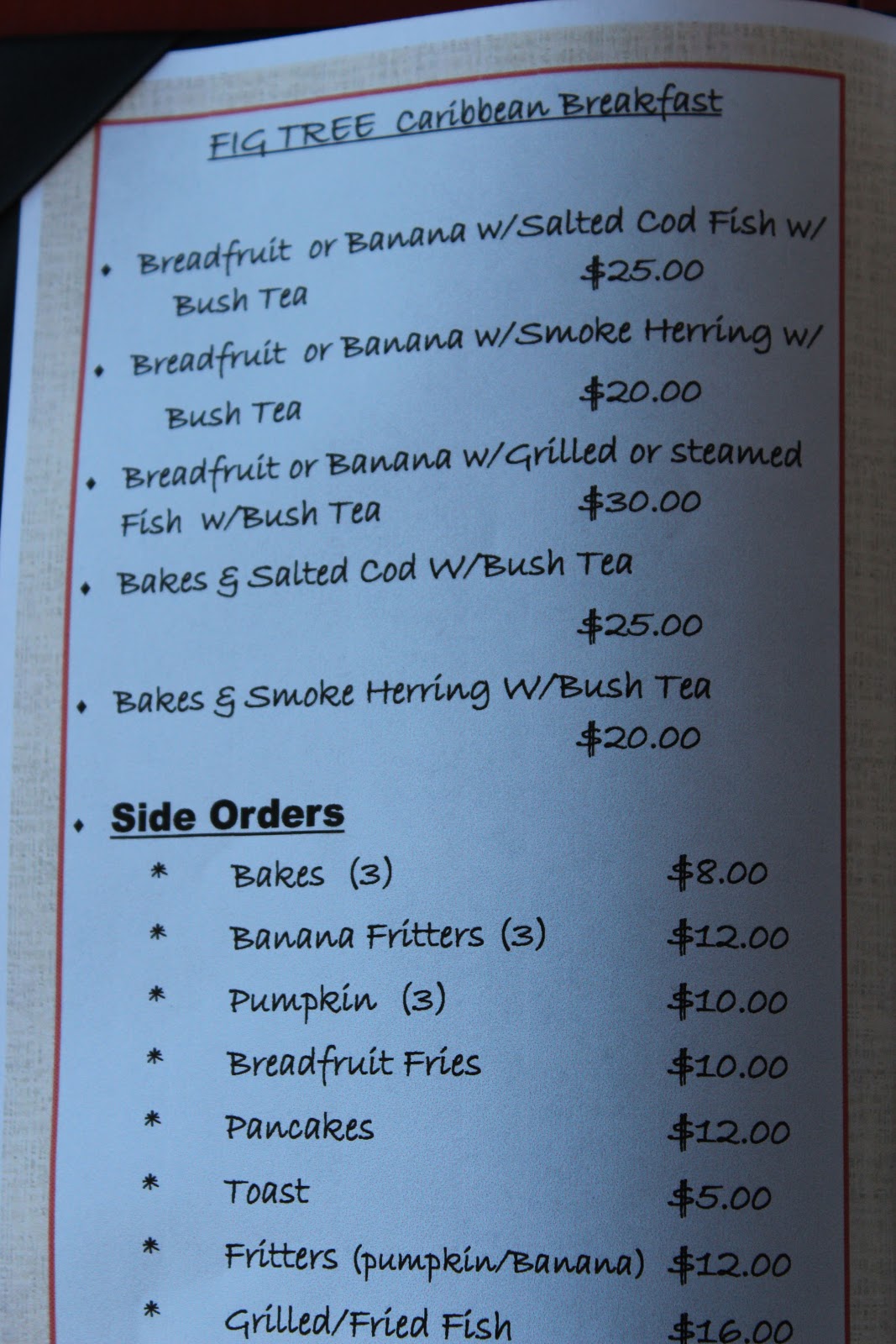
The Fig Tree Restaurant in the thriving metropolis of “the Belmont Sidewalk” (see last posting on the many towns of Bequia) just this week started serving traditional Caribbean breakfasts (see menu above). In what could be called an act of “research for my guidebook” but is more accurately described as “being hungry,” I went yesterday, accompanied by my sidekick Nick, who is always up for a good breakfast.

We had about an hour an a half before an appointment two towns (or one city block) over and knew that was cutting it pretty close, since there was one other customer there and only two waitresses, one of whom I believe was also cooking. One we had had serve us before, and knew that she was a very fastidious drink preparer – like a good half hour to bring bottled water, a lot of the time spent standing stock still in the bar and distressed at all the possible places the water might be. Soon (not really that soon, but I need a transition here) she would bring over a large and a small bottle to make sure we understood our choices (large is fine, we’ll share it). Then she has to return to the bar with BOTH bottles, because, I guess, they were only the demo bottles, and bring back a different large water bottle (“you said, large, right?” – though we might not have, dehydration starting to affect our memory).

Side note: When Nick and I go to the Fig Tree, we often do so because they have the most reliable Internet connection on the island, which is to say, not very but better than most. Because we are taking computers, we will sit at one of the large tables (see picture below, taken on the very day in question). So scene is set – 1000 words saved.

On returning with our actual large bottle of water, and not the demo large bottle of water, she stands with it, again silent and distressed, then (look at the picture again) asks Nick to move his computer because she can’t figure out where else to put the water.   After he does that, because it is better not to argue since there might be some sort of unknown feng shui reason that the water can only sit directly in front of Nick, she waits a couple of beats, then asks: Do you need glasses? No, no, this is great we assure her, we’ll just slug from the huge bottle, being so tight on space here at our enormous table.

So yesterday morning, when we saw the careful drink preparer on duty, I knew that I had to get my coffee order into the other waitress on call. But as she was heading toward us, Nick – damn him – asked, is the Internet working….

…Noooooo, it was like it was happening in slow motion. I moved to clap a hand over his mouth, but without caffeine, was too slow. Our waitress turned in mid-stride and without our coffee order. She wandered silently back toward the router and started checking the connection with her iPhone. Turns out, the Internet WAS working, just not on her iPhone, until about 30 minutes later – at which point she brought us the menus (or Nick tells me that’s what happened. I was face first on the table in coma).

Like a good set of smelling salts, the specter of breakfast with salt cod or boiled fish snapped me out of it in time to hear the blessed words: We don’t have any Caribbean breakfast.  She said both the smelly fish and the breadfruit deliveries were held up, or were never ordered, or were never even contemplated (this is communicated by a vague hand gesture which is the island signal for “something, somewhere, I really have no idea and don’t care”).

For me, this was tremendous news. While I would not say no to a nice bake (like flat rolls, freshly baked to order, and excellent as long as someone doesn’t put a bunch of boiled fish on top of it), I am not big on fish for breakfast, especially fish like salt cod which is preserved for lengthy sea voyages and meant to be eaten with a tankard of rum. And I can’t stand breadfruit, which tastes like neither fruit nor bread and has the consistency of Play-do but without the flavor.

And, in a later rare bit of research, I looked up what bush tea was – and the first entry I find (which means, as I understand, it must be accurate) is from the Jamaican Observer online edition and reads in part:

POPULAR bush remedies, or 'bush teas' widely consumed in Jamaica and other Caribbean nations have been found to be potentially harmful in recent scientific studies and appraisal by the University of the West Indies (UWI), Mona, St Andrew. Among the bush teas identified by the studies as favourites across the Caribbean are cerassie, annatto, peri-winkle, dandelion, vervine, guaco, cashew bark, coconut shell, aloe vera, and cannabis satira (marijuana). The studies said that although these "bushes" had possible beneficial ingredients, they also had potential toxins which could be harmful to individuals. It noted that use of bush remedies had greatly impacted the health of the region.

Dodged a bullet on that one…

So the menu that was on offer was the same selection found at every other restaurant on Bequia that serves breakfast: Eggs with bacon or not, toast (usually excellent homemade bread), pancakes, or an omelet (vegetarian OR cheese but not both, since I believe there is a law against it). Fruit juice or coffee.

We had omelets, which were quite good, and the rest of breakfast went off smoothly, though Nick asked not to have peppers in his omelet then joked that I could have his peppers. Ordering being a serious business here in the islands, that caused a delay while our waitress tried valiantly to figure out if there were not some sort of policy against pepper swapping (and whether that violated at least the spirit of the vegetable/cheese omelet distinction) and then spent another good while marveling that someone would joke about such a thing. Another brief snag occurred when the coffee showed up, hovered in its Holy-Grail-like silver pot on a tray with our coffee cups (we didn’t even have to ask for them!) right above our table, and then the waitress pull it back and went back to the kitchen because she had forgotten to put the milk on the tray (I don’t take milk! I don’t take milk!). But in the end, all was well, and we were only one half hour late for our appointment.

Note: The Fig Tree serves up some of the best West Indian cooking on the island, it is reasonably priced, and its Friday fish dinners are legendary (fish cooked any way, take out available, which is rare on the island and, if requested, usually leads to a leaky plastic bag of mixed up food some of which is bound to be breadfruit).  In addition, the place is a bit of a local hang-out, because of the good Internet and because owner Cheryl Johnson runs and hosts there the popular BequiaReading Club staffed by volunteers from the ex pat community and visiting yachters.

Other places for breakfast (same menu, without the fishy stuff) include the Gingerbread Restaurant (Belmont), which has a fabulous upstairs covered porch which gets a nice breeze and looks out over the bay (Internet costs $10 EC here, though, and involves a lot of work, a consultation with the manager, a trip for him back to some secret Internet room to get a printed receipt with your multi-character username and password, and that takes several entries to get the thing to work because the receipt printer is almost out of ink); Gingerbread also has a lovely outside area right on the water and under a big tree and a small bakery where you can get specialty coffees, fresh squeezed juices, and all manner of baked goods, including, not surprisingly gingerbread; The Frangipani (Belmont), which serves up the unexceptional standard fare unexceptionally (my next post will be a spot of creative writing about the Frangi); and Maria’s French Terrace (Port Elizabeth) where the omelet just edges out the Fig Tree’s for first place, but that is because the owner is French and really lays on the butter.


Monday, February 4, 2013

Bequia: Getting There


As this blog’s loyal readers (hi again, Mom) know, Active Voice is transitioning from a moderately successful writing and editing firm to pretty-much-destined-for-failure vanity publishing house specializing in Nick’s adventures novels (well, really only one at this point) and textbooks and my…various writing projects of an undefined nature and genre.


(This is the point where I remind everyone that I will still happily take speech and other writing gigs or corral my editors – who aren’t as enthusiastic about publishing our own stuff as they were about, say, real jobs – to clean up your presentation, proposal, report, or capabilities statement. The joy we feel at fulfilling our destiny as writers – not unlike the joy we felt at fulfilling our destiny as farmers – has yet to put any bread on the table (at least with farming we got the odd zucchini)).

The Active Voice offices are currently running our of a small apartment above Princess Margret Beach on the West Indian island of Bequia. We have been here two weeks and will stay another two.

Before we came, I decided that my first writing project would be a tourist guide to Bequia, with Nick filling in some of the historic bits, since he has researched the history of St. Vincent (Bequia is an hour ferry ride from St. Vincent, where the capitol is, and is part of the country St. Vincent and the Grenadines). He had planned to write a book on colonial times down here, which were quite exciting, with the British and the French both trying to wrest control of the various islands from each other and from the fierce native Black Caribs. Meanwhile, pirates sailed around through it all – Blackbeard spent a good deal of time in Bequia – wreaking havoc and conveniently crashing into rocks and spewing treasure around (that is Nick’s theory, anyway, which is why he brought his metal detector down here, and why he only has one pair of pants: he had to dump almost everything but the metal detector to make the Liat air baggage weight limit).

Nick pulled together a lot of source documents. We planned trips to libraries in New York and London to look at some of the original diaries written by the settlers (actually, Nick planned that, and I planned where we would go out to dinner afterwards). Then, a few months before we got here, Christopher Taylor – a real professor of Caribbean studies, if you can believe it, with a publishing company that he didn’t have to found himself -- released “The Black Carib Wars: Freedom, Survival, and the Making of the Garifuna.” We knew Nick’s project was dead when we read in the introduction something along the lines “thank you, Pierre François, for your help with my rusty Old French in translating a bunch of letters we had never heard of (of course not! They were in Old French! We don’t read Old French! We don’t even read Menu French!).”

So, we had to admit that the world probably didn’t need another history of the islands. No, what the world needed was a detailed work discrediting everything this so-called “Christopher Taylor” has ever written -- with chapters making fun of his physical features, which we hope and assume are grotesque (still looking for a picture). But, as we developed the business plan for the project (unless Christopher Taylor has some bitter ex-wives, probably fairly small target audience) and reviewed the libel laws, we realized that all the guy ever did was share our interests and be a lot smarter than us. So Nick decided instead to spend his time here looking for gold (which, if he finds it, he will take to Christopher Taylor’s house, fling it at him, and yell: “So, Pepe Le Pew, How come you didn’t know about this!”) and I was going to write a guidebook.

Was.

OK, maybe still am, but I have encountered several false starts.

Our first day here, I sat down to write the chapter that everyone knows is the first chapter in a guidebook: “Getting There.” Having just got here myself, I felt unusually qualified. I gathered:

The several grocery store-like receipts, stapled together and to my passport, that make up Liat air’s complicated ticketing system for its multiple stop flight (through three Caribbean countries and their unique and colorful immigrations and customs systems) from Puerto Rico to St. Vincent.

The schedule for the ferry from St. Vincent to Bequia. I didn’t have a ticket because we just got on the ferry, up the creaky metal plank behind the cars, then further up some very steep metal stairs (tip for the disabled traveller: Don’t get on this ferry.  I have no idea how you are supposed to get to Bequia) to where they store the humans for the ride. We had tried to buy a ticket at the office outside the ferry, the one with the sign that says “TICKETS FOR THE FERRY TO BEQUIA,” but there was no one in, and a guy in an official looking jumpsuit told us, derisively, “That’s not where you get tickets.” When Nick asked him, “Where then?” -- the guy yelled, “On de ferry! On de ferry!” introducing us to the quaint island tradition of explaining things to idiotic tourists (usually white, usually us) by bellowing simple instructions twice – under the assumption, I suppose that we are both deaf and incapable of understanding complete sentences. So, of course, no one asks for or sells us a ticket on the ferry, and we see no one else engaging in ticket commerce. Nick finally ended up just giving some money to a confused guy handing out mail on the lower deck when we arrived in Bequia.

These source documents assembled, I settled down to write and immediately realized I had missed several important steps. First, I should have a section on flights to Puerto Rico where you catch the Liat flight. But seriously, I would hope my readers are smart enough to know how to look up flights to Puerto Rico online, and if they aren’t, then I would not recommend Bequia as their first foray into air travel. Start someplace easy, like Cleveland.

Second, I needed to list some interesting hotels in San Juan, PR because, though your savvy Internet searches will show that American flight arriving in plenty of time for you to transfer to Liat and get to St. Vincent, in truth, Liat often pushes up its departure an hour or so if they have someone who wants to go to an island not normally on the itinerary.  And no, they don’t tell you when they do this. They don’t even announce it at the airport. You just have to be at the right gate within three hours of the scheduled departure, and eventually someone will open a door and say “Walk to that plane over there.”

Third, I forgot to explain how to get from the airport to the ferry once you land in St. Vincent. You can’t. The plane doesn’t get in until late and the last ferry goes at 5 PM. So you will be spending a night in St. Vincent too. Again, a proper guidebook would have a list of hotel options for St. Vincent and information on how to negotiate with the cab drivers outside the airport (you can’t. It is dark, you have no idea where you are, you forgot the exchange rate, and you can’t understand anything they are saying), but what is just much easier is for you to stay at Tranquility Beach Apartment Hotel, and Lucelle will pick you up at the airport and take you to the ferry the next morning.  Just don’t ask her to go early, because of all the traffic, and there is no sense in that (or, as she told us: “No sense in that! No sense in that!).

Lucelle, smiling because you are not making her go into town during morning rush hour.
Bottom line: It takes three days to get to Bequia through St. Vincent, making it not the best place for a one-week vacation.  If you are determined, you could try a regular airline to Barbados then SVG airlines to Bequia’s own airport. The New York Times ran an article on Bequia a couple of years ago (“Bequia: Getting AwayFrom the Getaways”), and their reporter left New York at 8 AM and got to his hotel on Bequia by 5:30. (He said that “getting there requires a bit of effort, patience and expense,” but, since he did it in less than 24 hours, I would have added to his list “…and incredible luck”).

In the interest of a well-researched guidebook, I checked out SVG’s website to see if perhaps we had been foolish to use the St. Vincent route all these years, and pretty much the first thing they tell you is to make sure that before you board, you have a toothbrush and any medicine you might need in the next week or so, because chances are, you -- or you and your luggage -- are not getting “there” anytime soon. 

Chapter One of the book, therefore, remains unwritten because I am afraid that compiling all this inside information in a useful way will be (a) exhausting and (b) depressing, so I put this chapter aside to tackle the also-standard: Where to Eat.

Next blog post: Why I also do not have a chapter yet on where to eat.